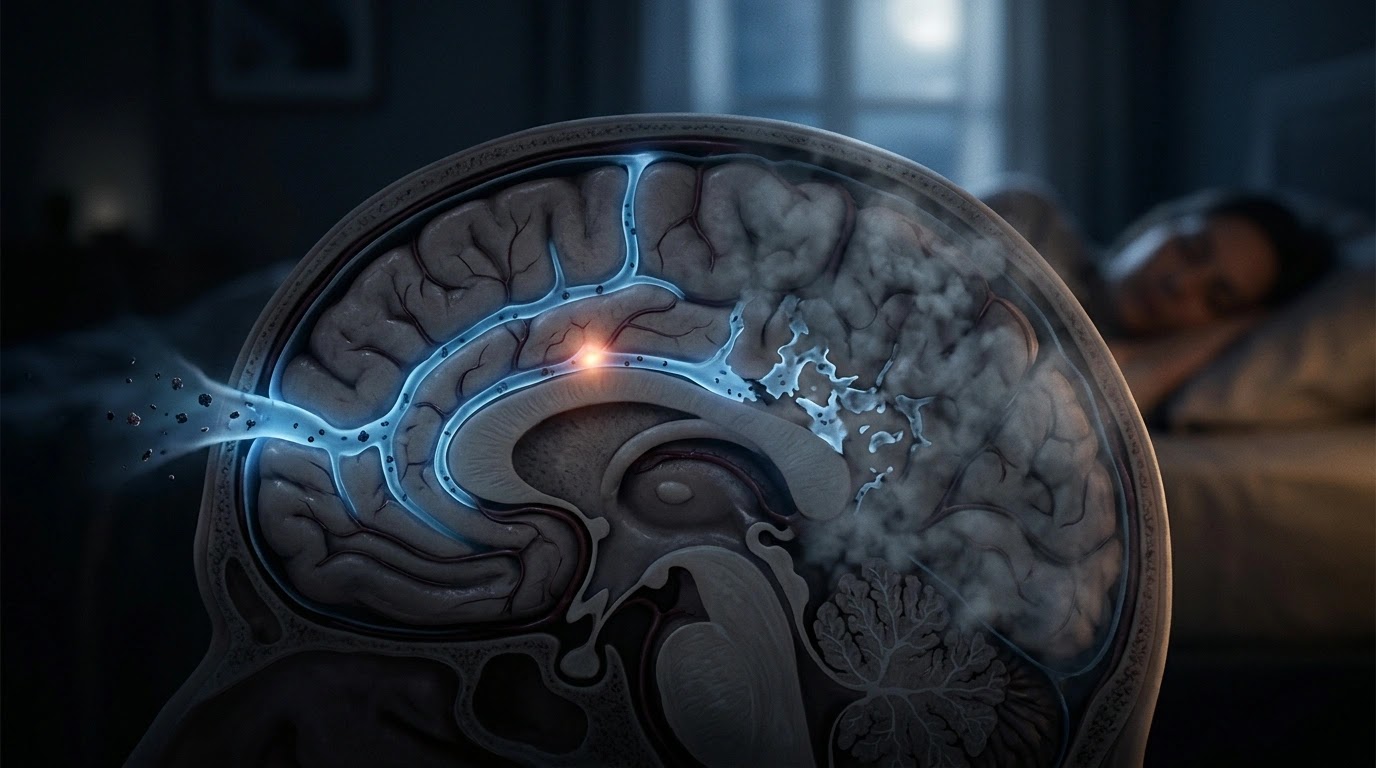
Waking up with heavy brain fog after eight full hours in bed usually points to an invisible failure of sleep micro-architecture: your glymphatic system never finished cleaning your brain.
Consumer sleep trackers measure total sleep time, heart rate, and rough estimates of sleep stages. They often reward fragmented sleep with an "optimal" score of 85 or 90 because you never formally woke up or got out of bed.
Beneath your conscious awareness, brief neurological flickers called micro-arousals (lasting between 3 and 15 seconds) can occur dozens of times per hour. Each micro-arousal triggers a spike of stress chemistry in the brain stem. That chemical spike physically contracts the spaces between your brain cells, shuts down internal fluid transport, and leaves metabolic waste sitting in your neural tissue overnight.
How the Brain Flushes Waste: The Glymphatic System
During the day, active neurons consume vast amounts of energy, generating metabolic waste products. These include amyloid-beta peptides, hyperphosphorylated tau proteins, and metabolic lactate. If these byproducts accumulate, they degrade cellular communication, trigger neuroinflammation, and produce the cognitive sluggishness commonly described as brain fog.
The body clears metabolic waste through the lymphatic system, but the central nervous system lacks traditional lymphatic vessels throughout its tissue. Instead, the brain relies on the glymphatic system, a specialized hydraulic network that uses cerebrospinal fluid (CSF) to wash the brain from the inside out.
[Deep SWS / Delta <1 Hz] ──> [Locus Coeruleus Quiescence / Low Norepinephrine]
                                       │
                                       ▼
                        [Astrocytic AQP4 Polarization]
                                       │
                 ┌─────────────────────┴─────────────────────┐
                 ▼                                           ▼
   [Extracellular Space Expands:               [Infraslow Vasomotion:
     α rises from 0.14 to 0.23]                 Arterial Pumping ~0.02 Hz]
                 │                                           │
                 └─────────────────────┬─────────────────────┘
                                       ▼
                     [Unimpeded Convective Fluid Flush]
Cerebrospinal fluid pools along the outside of cerebral arteries in ring-like channels called Virchow-Robin spaces. Specialized support cells called astrocytes wrap their microscopic "endfeet" around these blood vessels.
These astrocytic endfeet are studded with water channels known as Aquaporin-4 (AQP4). In a healthy state, AQP4 channels concentrate directly along the vessel walls—a state called polarization. When polarized, these channels act like directed nozzles, driving fluid out of the arterial channels, through the brain tissue (the interstitial space), and out through the venous system, carrying metabolic waste with it.
The Interstitial Bottleneck: Why Fluid Cannot Flow During the Day
Fluid cannot move effectively through the brain while you are awake. The physical barrier is something neuroscientists call the interstitial space volume fraction, represented by the Greek letter alpha ($\alpha$).
Alpha measures how much of your total brain volume consists of empty space between cells.
-
During wakefulness: Brain cells swell slightly, and the extracellular space is tightly packed. Alpha sits at roughly 14% ($\alpha \approx 0.14$). Trying to push fluid through brain tissue in this state is like forcing water through densely packed clay.
-
During consolidated deep sleep: Brain cells shrink, driving alpha up to roughly 23% ($\alpha \approx 0.23$). This represents a 60% expansion of the gaps between your neurons.
According to the laws of fluid dynamics in porous media (governed by Darcy’s Law), fluid resistance drops exponentially when channel width expands. That 60% physical expansion transforms compacted clay into loose gravel, allowing cerebrospinal fluid to rush through the parenchyma and flush out waste.
The Chemical Gatekeeper: Locus Coeruleus and Norepinephrine
The switch that opens or closes this interstitial space is norepinephrine, the brain’s primary chemical messenger for alertness, vigilance, and stress.
Norepinephrine is manufactured and distributed by a small cluster of neurons in the brainstem called the locus coeruleus (LC).
When you are awake, the locus coeruleus fires steadily, bathing the cortex in norepinephrine to maintain attention. This high noradrenergic tone acts on astrocytic receptors, keeping the extracellular pathways clamped shut.
For the brain to open its interstitial channels, the locus coeruleus must fall quiet. During consolidated slow-wave sleep (the deepest phase of non-REM sleep, characterized by electrical delta waves below 1 Hz), locus coeruleus activity drops to its lowest baseline. As noradrenergic tone falls, astrocytic swelling recedes, the extracellular space expands to its full 23% volume, and waste clearance begins.
The Vasomotion Engine: The Brain's Rhythmic Mechanical Pump
Glymphatic clearance does not rely on passive diffusion alone. It requires active physical pumping.
In healthy slow-wave sleep, the locus coeruleus does not completely shut off like an unplugged machine. Instead, it pulses in an ultra-slow, rhythmic wave known as an infraslow oscillation (~0.02 Hz), repeating roughly once every 50 seconds.
These subtle, coordinated pulses drive vasomotion—the rhythmic, synchronized contraction and dilation of cerebral blood vessel walls.
When a cerebral artery constricts slightly, it creates a negative pressure wave within the surrounding Virchow-Robin space, drawing a surge of cerebrospinal fluid deep into the brain tissue. When the vessel relaxes, fluid washes outward through the interstitial matrix toward drainage pathways.
Slow-wave sleep couples electrophysiological slow waves, dips in cerebral blood volume, and large, pulsatile waves of fluid through the ventricles. Without steady, rhythmic vasomotion, the brain loses the physical mechanical pump needed to drive convective fluid exchange.
How Micro-Arousals Break the Clearing Cycle
A micro-arousal is a sudden, brief shift in brain wave activity lasting between 3 and 15 seconds. On an electroencephalogram (EEG), the brain abruptly jumps from slow, rolling delta waves into fast, waking frequencies such as alpha, theta, or beta waves (>16 Hz).
Because these events last only a few seconds, they do not produce conscious awakenings. You do not roll over, open your eyes, or remember them the next day. However, they completely reset your neurochemistry.
During a micro-arousal, the quiet locus coeruleus fires a sharp burst of norepinephrine across the cortex. This surge causes immediate physiological damage to the clearance process:
-
Extracellular collapse: Norepinephrine instantly binds to cortical adrenergic receptors, collapsing the interstitial volume fraction back toward the waking level of 14%.
-
Pump failure: The sudden noradrenergic spike breaks the cadence of the 0.02 Hz infraslow rhythm, arresting arterial vasomotion mid-stroke.
-
Channel depolarization: Frequent arousals cause Aquaporin-4 water channels to drift away from the perivascular endfeet and spread diffusely across the entire astrocyte body. Without polarized channels focused on the vessel walls, directional fluid flow disappears.
If you experience 20 to 30 micro-arousals an hour, your brain repeatedly attempts to initiate the clearance cascade, only to have the hydraulic gate slammed shut every two to three minutes. You spend eight hours unconscious, but your brain tissue experiences the fluid dynamics of being awake.
Consolidated Slow-Wave Sleep:
Delta Waves (<1 Hz) ──> Low Norepinephrine ──> Wide Channels (α = 0.23) ──> Vasomotion Pump Active ──> Fluid Flushes Waste

Micro-Arousal Interruption:
EEG Shift (3–15s)   ──> Norepinephrine Spike ──> Channels Clamp (α = 0.14) ──> Vasomotion Stalls       ──> Waste Remains Trapped
The Wearable Illusion: Why Trackers Miss Micro-Arousals
Most consumer wearables evaluate sleep quality through two primary tools: accelerometry (measuring physical movement) and photoplethysmography (PPG) (measuring pulse rate and heart rate variability at the wrist or finger).
These sensors work well for identifying gross macro-architecture. They detect when you lie down, when your heart rate drops, and when you move around.
Micro-arousals operate beneath the detection threshold of consumer hardware:
-
A 5-second burst of fast brain waves does not cause gross motor movement.
-
A brief locus coeruleus discharge triggers localized central nervous system changes before any large, sustained spike in peripheral heart rate registers at the wrist.
-
Coarse algorithms categorize these intervals as deep non-REM sleep simply because the body remains stationary and average heart rate stays low.
A sleep tracker may show two hours of deep sleep and an optimal recovery score, even when dozens of micro-arousals have repeatedly aborted the glymphatic cycle.
The Sedative Paradox: Why Sleeping Pills Leave the Brain Unwashed
When people struggle with unrefreshing sleep, they often use sedative medications or over-the-counter sleep aids.
Many pharmaceutical hypnotics (such as zolpidem) operate by enhancing GABA-A receptor activity. These compounds force the brain into high-voltage, slow-wave electrical patterns on an EEG, making a person unconscious quickly.
However, unconsciousness is not the same as restorative sleep architecture:
-
GABA-modulating sedatives flatten natural infraslow locus coeruleus oscillations by as much as 50%.
-
Blunting these slow neurochemical waves disables the arterial vasomotion engine.
-
Tracer imaging demonstrates that suppressing these natural rhythms reduces fluid transport into the brain tissue by more than 30%.
The user is sedated, but the biological wash cycle never runs. This biochemical standstill explains the distinct, heavy mental fog—the "hypnotic hangover"—that frequently follows chemically induced sleep.
Common Hidden Triggers of Sleep Micro-Fragmentation
Because micro-arousals produce no conscious memory, identifying them requires looking at the physiological and environmental stresses that provoke locus coeruleus activation.
| Trigger | Mechanism | Physiological Impact | | :--- | :--- | :--- | | Upper Airway Resistance (UARS) | Subtle soft-tissue collapse in the airway increases the physical effort needed to inhale, without fully stopping airflow like classic apnea. | The autonomic nervous system senses negative intrathoracic pressure, releasing norepinephrine to stiffen airway muscles. | | Late-Night Alcohol Metabolism | As the liver clears ethanol, the brain experiences a rebound drop in GABA activity and a surge in sympathetic tone during the second half of the night. | Suppresses slow-wave delta power and triggers frequent, periodic EEG micro-awakenings. | | Acoustic Disturbance | Sub-perceptual background noises (traffic, HVAC cycling, household shifts) register in the auditory cortex even during deep unconsciousness. | Activates the locus coeruleus vigilance network without causing behavioral wakefulness. | | Elevated Core Temperature | Peripheral blood vessels cannot dump heat if the bedroom is too warm or bedding is non-breathable. | Prevents the 1°C core body temperature drop required to stabilize prolonged, consolidated delta sleep. |
Protecting the Micro-Architecture of Sleep
Improving glymphatic clearance requires shifting focus from the quantity of sleep to the continuity of the slow-wave state. Stabilizing the micro-architecture of sleep means eliminating the triggers that stimulate the locus coeruleus overnight.
Protect Airway Patency
Subtle breathing resistance is the primary driver of sub-perceptual micro-arousals. If you wake with a dry mouth or nasal congestion, airway resistance is likely fracturing your deep sleep. Clear nasal passages before bed using saline rinses, manage indoor allergens, and address chronic mouth breathing. If daytime grogginess persists despite clean sleep habits, get evaluated for Upper Airway Resistance Syndrome (UARS) or obstructive sleep apnea with an overnight clinical polysomnography test that records genuine EEG micro-arousals.
Eliminate Late Sympathetic Provocations
Chemical stress in the evening prevents the locus coeruleus from reaching baseline quiescence. Stop drinking alcohol at least four hours before bed to avoid the sympathetic rebound that fractures deep sleep in the early morning hours. Similarly, avoid high-glycemic or heavy meals late in the evening; digestive strain and nocturnal blood sugar fluctuations stimulate autonomic arousals that interrupt infraslow vasomotion.
Anchor Bedroom Acoustics
The auditory system monitors the environment for threats throughout all sleep stages. Even when a noise is not loud enough to wake you, it registers in the brainstem and triggers an autonomic micro-arousal. Mask variable ambient sounds with a steady, low-frequency sound profile, such as continuous pink noise or a mechanical fan. Stable background sound protects the locus coeruleus from reacting to unpredictable environmental spikes.
Manage Temperature Regulation
The brain requires a steady drop in core temperature to sustain slow-wave sleep. Keep your bedroom cool (ideally between 60°F and 67°F or 15°C and 19°C) and choose natural, breathable bedding that dissipates body heat. Sleeping in an overheated room keeps baseline sympathetic tone elevated, making the locus coeruleus far more reactive to minor sensory triggers.
Frequently Asked Questions
Can an Apple Watch or Oura Ring detect micro-arousals?
No. Consumer trackers rely on wrist movement and pulse measurements. A micro-arousal lasts only 3 to 15 seconds, which alters cortical brain waves without necessarily causing physical movement or a sustained heart rate spike. Only an electroencephalogram (EEG) can confirm micro-arousals.
How do I know if micro-arousals are stalling my glymphatic clearance?
The clearest indicator is waking with heavy brain fog, headache-like pressure, and sluggish executive function despite spending seven to eight quiet hours in bed. If your sleep tracker shows normal deep sleep percentages but your subjective mental clarity remains severely blunted, fragmented micro-architecture is a prime suspect.
Does drinking more water improve glymphatic waste clearance?
Hydration supports normal blood volume and systemic fluid dynamics, but it does not open the brain's waste pathways. Glymphatic clearance depends on the physical expansion of the interstitial space and active arterial vasomotion. Both processes are regulated by neurochemistry during deep, uninterrupted slow-wave sleep, not by fluid intake.
Are sleep aids like Ambien bad for brain cleansing?
Sedatives force the brain into slow-wave electrical patterns on paper, but they blunt the natural, rhythmic norepinephrine oscillations that drive arterial pumping. Studies show this suppression reduces cerebrospinal fluid influx into the brain parenchyma by more than 30%, which explains why sedated sleep rarely feels cognitively restorative.