Look at the constellation Orion on a crisp winter night. Just below his belt hangs a fuzzy patch of light. It looks like a faint, hazy star to the naked eye, but a telescope reveals something staggering. This is the Orion Nebula, a colossal cloud of gas and dust where thousands of stars are being born right now. It is a cosmic nursery, busy and loud in frequencies we cannot hear, and the universe is full of them.
Stars seem eternal. Our ancestors mapped the same fixed patterns millennia ago. Yet no star lives forever. They are born, they burn, and they die. Their life cycles span millions to billions of years, yet every stage reshapes the cosmos around them. To understand a star is to understand the story of the universe itself, including our own origins. We are, in a very real sense, part of their legacy.
Stellar Nurseries: Where Stars Are Born
Deep space is not empty. It is filled with enormous clouds of cold hydrogen gas and microscopic dust grains. These are molecular clouds, and they are the maternity wards of the universe. Some stretch across hundreds of light years and contain enough mass to make millions of suns. They drift through the galaxy, dark and silent, nearly invisible, until something nudges them.
Maybe the shockwave from a nearby supernova compresses a region. Maybe two clouds collide, or the spiral arm of a galaxy sweeps through. Whatever the trigger, gravity seizes the opportunity. Over millions of years, a dense pocket within the cloud begins to collapse under its own immense weight. It spins slowly, flattening into a disk, while the center gets hotter and denser. This is a protostar, a stellar embryo wrapped in a thick cocoon of dust.
For the longest time, we could not see past that dust. Visible light cannot penetrate it. Then the James Webb Space Telescope turned its infrared gaze toward nurseries like the Carina Nebula. Infrared light slips right through the haze. Webb revealed newborn stars in breathtaking clarity, caught in the act of creation, still wreathed in their dusty placentas. We were watching the universe give birth.
But a protostar is not yet a star. It is still cooling off from its violent formation, radiating away gravitational energy. Something crucial has to happen before it truly ignites and joins the stellar ranks.
The Moment a Star Is Born
The core of a protostar keeps contracting. Pressure builds relentlessly. Temperature soars past thousands, then millions of degrees. When the center hits roughly 10 million Kelvin, hydrogen nuclei finally slam together hard enough to fuse into helium. This is nuclear fusion, and it changes everything.
Think of it like a trillion trillion tiny thermonuclear bombs detonating every second, all held in place by the star's own crushing gravity. The outward push of radiation and hot gas balances the inward pull of mass. This delicate balance, called hydrostatic equilibrium, is what defines a true star. Once it is achieved, the object settles onto the main sequence, the longest and most stable phase of stellar life.
Our Sun has lived in this phase for about 4.6 billion years. Every single second, it converts roughly 600 million tons of hydrogen into helium. The energy released takes thousands of years to random walk out of the core, then eight minutes to reach us. It is an astonishingly efficient engine. Yet not all stars live the same way. The biggest factor in a star's fate was decided at its birth.
Mass Is Destiny
If you want to know how a star will die, look at its mass. Mass determines nearly everything: temperature, brightness, lifespan, and ultimate fate. It is the single most important number in a star's biography, the cosmic DNA that seals its destiny.
Low mass stars, like red dwarfs, burn their fuel so slowly and coolly that they can last for hundreds of billions of years. They are thrifty, sipping hydrogen instead of guzzling it. The universe itself is only 13.8 billion years old, so not a single red dwarf has ever died of old age. They are still in cosmic kindergarten, barely begun.
On the other hand, massive stars are gluttons. A star twenty times the mass of our Sun might spend just a few million years on the main sequence before exhausting its fuel. It lives fast and dies young, shining so brightly it can outshine a million suns. The difference between a candle and a bonfire is not just size. It is lifespan, intensity, and the manner of the final flicker.
So what happens when the fuel finally runs out? That depends entirely on which category the star belongs to.
The Quiet Goodbye
Our Sun is a middle of the road star, which makes its fate a textbook example for low to medium mass objects. In about 5 billion years, the hydrogen in its core will start to run low. The nuclear fires will dim. Without sufficient outward pressure, gravity gains the upper hand. The core contracts and heats up, while the outer layers swell outward like a heated balloon.
The Sun will become a red giant. Its surface will expand so far that it may swallow Mercury and possibly Venus. Earth will probably not be consumed, but it will be scorched into a lifeless cinder, its oceans boiled away. For a brief cosmic moment, the Sun will loom hundreds of times larger in the sky than it does today. The inner solar system will become unrecognizable.
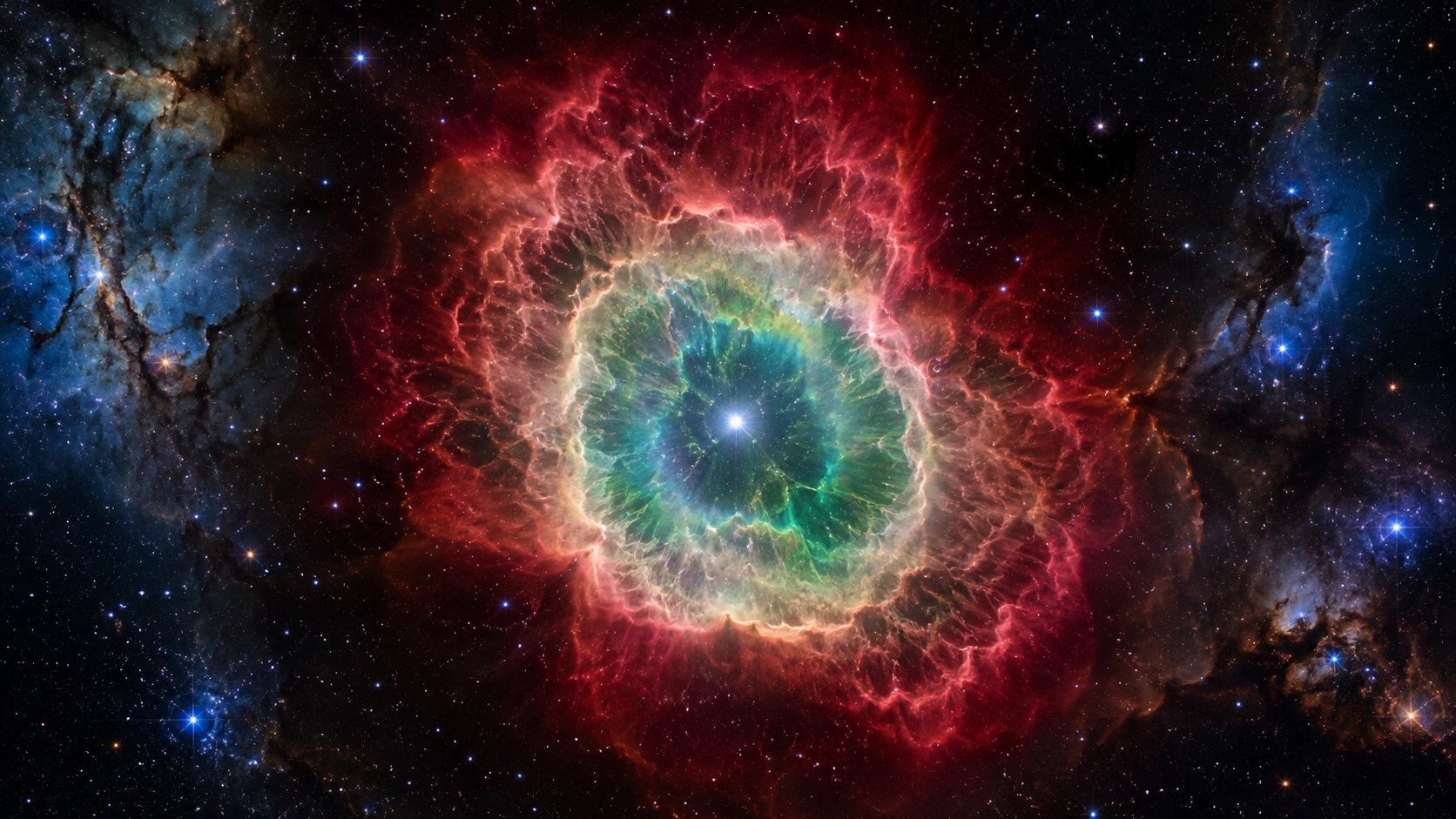
Eventually the core gets hot enough to fuse helium into carbon and oxygen. When that fuel too is spent, the core can no longer support itself. The outer layers drift away into space, forming a beautiful, glowing shell called a planetary nebula. The name is a historical mistake. Early astronomers like William Herschel thought these greenish disks looked like distant planets, but they are actually the funeral shrouds of dying stars. Ionized oxygen glows emerald, hydrogen blushes red, and the result is one of the most gorgeous objects in the sky.
Left behind is the core itself. Stripped of its outer layers, it becomes a white dwarf. It is roughly Earth sized but contains about half the mass of the Sun compressed into an incredible density. A single teaspoon of white dwarf material would weigh about as much as an elephant. Over billions of years it will cool and fade, eventually becoming a cold, dark cinder called a black dwarf. None exist yet because the universe has not been around long enough for white dwarfs to cool that far. We are too early in cosmic history to see the final stage.
That is the gentle path. But for the heavyweights, the universe has something far more dramatic in store.
When Giants Fall
A massive star does not go quietly. Its core is a furnace of staggering complexity. After hydrogen fusion stops, the core contracts and begins burning helium. Then carbon. Then neon, oxygen, and finally silicon. The star develops layers like the rings of an onion, with progressively heavier elements surrounding an iron core.
Here is the problem. Iron is special. Fusing iron does not release energy. It absorbs it. So when the core fills with iron, the nuclear fire goes out. Gravity wins instantly. In a fraction of a second, the core collapses at speeds reaching a quarter of the speed of light. Temperatures spike to 100 billion degrees. The collapse is so violent that it squeezes protons and electrons together, forming neutrons. The collapse halts abruptly when the core becomes as dense as an atomic nucleus. The infalling material rebounds in a cataclysmic shockwave. The star explodes.
This is a Type II supernova. For a few weeks, the explosion can outshine an entire galaxy of billions of stars. In that brilliant moment, elements heavier than iron are forged in the chaos. Gold, silver, platinum, uranium. The shockwave blasts these freshly minted elements across space, seeding future molecular clouds with the raw material for new stars, planets, and eventually living things.
What remains? If the core was between about 1.4 and 3 times the mass of the Sun, it becomes a neutron star. Imagine crushing the entire Sun down to a ball only 20 kilometers wide. A sugar cube of neutron star material would weigh billions of tons. These stars spin rapidly, sometimes hundreds of times per second, beaming radiation from their magnetic poles like cosmic lighthouses. We call them pulsars. You can set a clock by them.
If the core is heavier than roughly 3 solar masses, nothing can stop the collapse. Not even the repulsive force between neutrons. The core becomes a black hole, a region where space and time fold in on themselves and nothing, not even light, can break free.
We Are Made of Stardust
In 1973, Carl Sagan told the world something profound. "We are made of star stuff." He was not merely being poetic, though it sounds that way. He was being absolutely literal.
The hydrogen in your body comes from the Big Bang itself, but the carbon in your cells, the oxygen in your lungs, the calcium in your bones, and the iron in your blood were all cooked inside stars. The truly heavy elements, like the gold in your jewelry, the iodine in your thyroid, or the uranium in the Earth, were forged in the explosive deaths of massive stars or in the cataclysmic collisions of neutron stars.
Every generation of stars enriches the galaxy. When a star dies, its material drifts into the interstellar medium, mixing with fresh hydrogen to form new molecular clouds. Those clouds collapse into new stars, some with rocky planets made entirely of recycled star stuff. The calcium that builds seashells, the magnesium in chlorophyll, the silicon in rocks, the sodium in your nerves. All of it was processed through stellar furnaces billions of years before the Earth existed.
The Story Continues
Next time you look up at the night sky, remember this. Every pinprick of light is a story. Some are infants, just beginning to shine in fresh nurseries. Others are elders, burning through their final reserves. And some of the light you see comes from stars that died long ago, their last farewell still traveling across the cosmos to reach your eyes.
You are not separate from this drama. You are part of it. The atoms in your hands were once inside a star. That star lived, burned, and died so that, billions of years later, you could stand here and look up at the sky, wondering where it all began.