The Whisper from the Dawn of Time
Imagine holding a seashell to your ear. That gentle, static‑like hiss you hear? There’s a version of that which fills the entire cosmos. Only this one isn’t ocean waves trapped in a shell—it’s the afterglow of the universe’s birth. A fossil. A whisper from 13.8 billion years ago.
Run the universe’s movie backwards. Galaxies rush toward each other, stars un‑burn, the cosmos gets hotter and denser. Keep rewinding and you eventually land on a moment where everything—space, time, matter, energy—was squeezed into an inconceivably small, hot speck. That’s what we call the Big Bang.
But here’s the first mental twist: the Big Bang wasn’t an explosion in space. It was space itself stretching. Like raisins in a rising loaf of bread, the galaxies aren’t flying through a pre‑existing room; the dough itself expands, carrying the raisins apart. This distinction changes everything.
The Man Who Wouldn’t Believe His Own Equation
In the early 20th century, the universe was thought to be static, eternal, and unchanging. Einstein’s equations of general relativity naturally suggested a dynamic universe—one that could expand or collapse—but he found this so unsettling that he added a “cosmological constant” to force the math into a steady state. He later called it his greatest blunder.
Meanwhile, a Belgian priest and physicist named Georges Lemaître saw what Einstein missed. In 1927, Lemaître proposed that the universe began from a “primeval atom” and has been expanding ever since. A few years later, Edwin Hubble observed distant galaxies racing away from us; the farther they were, the faster they fled. The universe was indeed growing. The Big Bang theory—though not yet called that—had its first solid evidence.
So what happened in those first moments?
The First Three Minutes
We often picture the Big Bang as a flash of light, but for the first 380,000 years the universe was completely dark. That’s because it was so hot that electrons couldn’t settle into atoms. Instead, a seething, opaque plasma of charged particles filled everything.
But let’s rewind even further.
In the tiniest fraction of a second—10−36 seconds after the beginning—the universe underwent a mind‑boggling growth spurt called inflation. In a blink, it expanded by a factor of at least 1026. Subatomic ripples that formed during this inflationary burst would later become the seeds of galaxies. Once inflation ended, the hot soup of quarks and gluons began to cool. Within the first three minutes, protons and neutrons stuck together to form the nuclei of hydrogen and helium. That’s it. All the heavier elements would come much later, forged inside stars.
The early universe was now a dense, opaque fog. Photons—particles of light—kept bouncing off free electrons, unable to travel freely. If you could somehow stand inside it, you’d see nothing but a blinding, glowing white wall.
And then, the fog lifted.
The Surface of Last Scattering
Around 380,000 years after the Big Bang, the temperature had dropped to about 3000 Kelvin—cool enough for electrons to finally latch onto atomic nuclei. In a cosmic instant, the fog cleared. Photons streamed across the universe for the first time. This “surface of last scattering” is the oldest light we can ever hope to see. Everything before it is hidden behind an opaque curtain.
But that ancient light didn’t stay bright. As space continued to expand, the wavelengths of those photons stretched, sliding down the electromagnetic spectrum. Today, after billions of years of stretching, that light reaches us not as visible glow but as faint microwaves. We call it the Cosmic Microwave Background, or CMB.
Now, here’s where the story takes a hilariously human turn.
Pigeons, a Horn Antenna, and a Nobel Prize
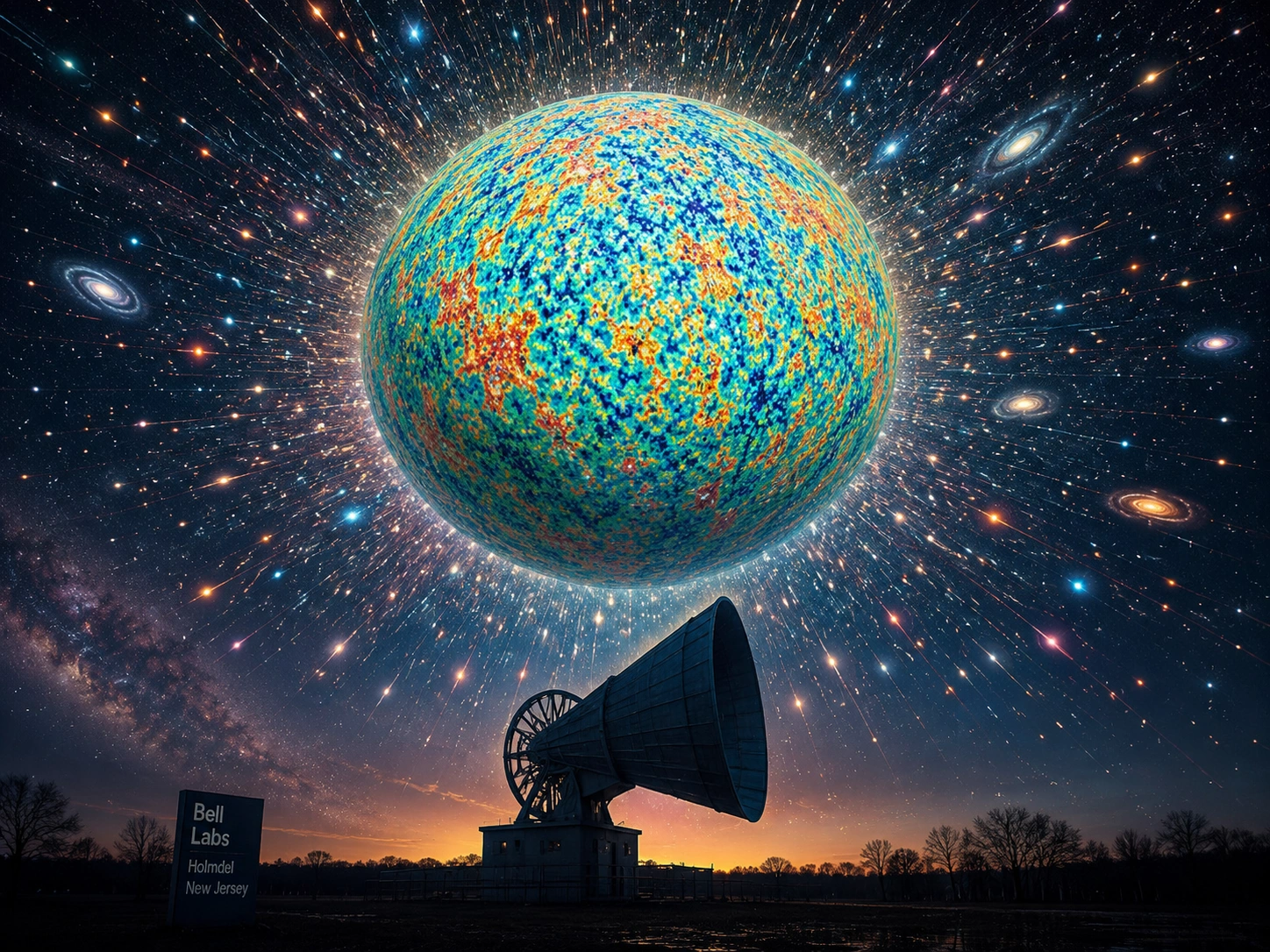
In 1964, two radio astronomers at Bell Labs—Arno Penzias and Robert Wilson—were working with a giant, horn‑shaped antenna in New Jersey. They wanted to detect faint radio signals bouncing off satellites, but they kept picking up a persistent, low‑level hiss. No matter where they pointed the antenna, day or night, the noise remained.
At first, they blamed the equipment. They even crawled inside the horn and found a pair of pigeons nesting there, their droppings coating the sensitive surfaces. The birds were evicted, the horn cleaned, but the hiss remained.
Unbeknownst to them, a team at Princeton had recently predicted that if the Big Bang happened, the universe should still glow with a faint microwave afterglow at about 3 Kelvin. Penzias and Wilson’s stubborn noise? It matched that prediction exactly. The static they’d been chasing was, in fact, the echo of creation.
They won the 1978 Nobel Prize in Physics. The pigeons, presumably, did not.
The Baby Picture of the Cosmos
At first glance, the CMB looked almost perfectly uniform—2.725 Kelvin in every direction. A cosmos so smooth you could get bored. But then astronomers began to look closer.
In 1992, NASA’s COBE satellite detected minuscule temperature differences in the CMB: ripples of just one part in 100,000. These anisotropies weren’t random noise; they were the fingerprints of those early quantum fluctuations amplified by inflation. Denser patches would eventually attract matter and grow into galaxies and clusters. Without these tiny imperfections, the universe would be a featureless, lifeless void.
WMAP and later the Planck satellite mapped these ripples in exquisite detail. What emerged was a baby picture of the universe at just 380,000 years old—showing us the blueprint of all cosmic structure to come.
From that image, cosmologists could decode an entire cosmic recipe. The CMB tells us that the universe is flat (within experimental limits), 13.8 billion years old, and composed of roughly 5% ordinary matter, 27% dark matter, and 68% dark energy. The Big Bang’s afterglow essentially handed us the universe’s birth certificate, complete with its vital statistics.
The Unknown Still Humming
As powerful as the CMB is, it hasn’t answered everything. The very first signal—the B‑mode polarization from primordial gravitational waves generated during inflation—remains elusive. Detecting it would prove inflation happened and open a window to physics far beyond the Standard Model.
There’s also the growing “Hubble tension”: different methods give slightly different values for the universe’s expansion rate. Resolving this could point to new physics. Future missions like the Simons Observatory, CMB‑S4, and LiteBIRD are racing to squeeze every secret from the background glow.
We’ve come a long way from blaming pigeon droppings for the universe’s oldest light. Today, every time you switch on an old analog TV and see static, about 1% of that snow comes straight from the Big Bang. The universe is still whispering. The question is, what will it tell us next?